0

Smart Residential Mail & Parcel Locker

Smart mail and parcel locker offering dedicated apartment cells and shared lockers for oversized parcels

Request Quote

Autonomous parcel and mail management solution for residential buildings.

Smart Mail & Parcel Locker is a secure, self-service system that enables 24/7 parcel and mail collection within apartment buildings, ensuring controlled storage and seamless handover between couriers and residents.

It enables developers and property managers to integrate structured last-meter logistics infrastructure directly into residential projects, aligned with the growing volume of e-commerce deliveries.
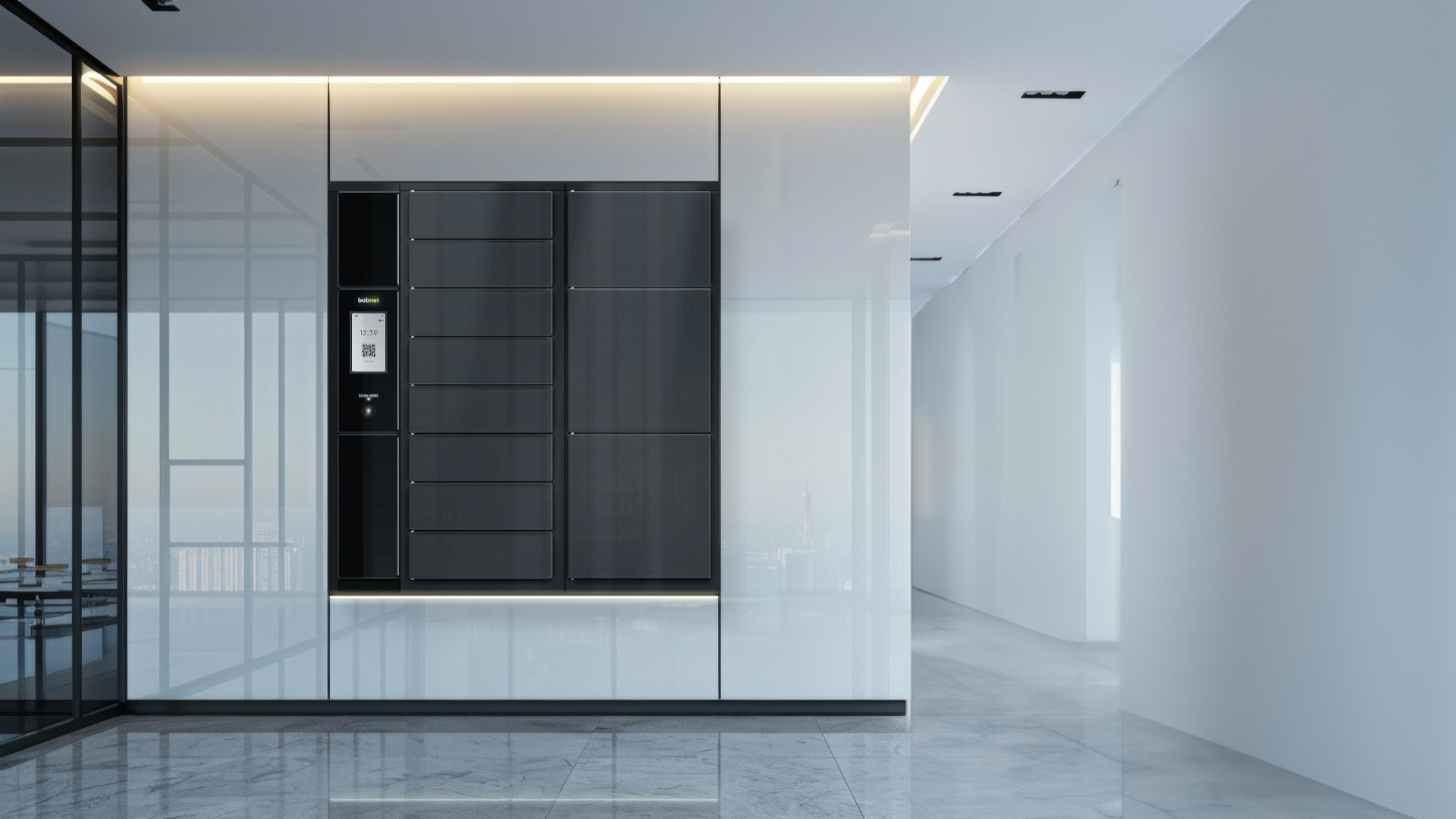
bobnet Smart Residential Mail & Parcel Locker


bobnet Smart Residential Mail & Parcel Locker

  • Reduces manual parcel handling by staff
  • Eliminates missed deliveries and cluttered reception areas
  • Supports 24/7 access without additional personnel
  • Residential-specific impact
  • Improves resident satisfaction
  • Essential for multi-unit buildings
  • Scales easily with building occupancy

The Smart Residential Mail & Parcel Locker is built using modular steel enclosures designed for durability, easy installation, and aesthetic integration in both indoor and outdoor environments.

Casing & Materials

The device body is made of 1.0–1.5 mm steel, finished with a high-durability polymer paint coating.

  • Indoor version: painted steel structure
  • Outdoor version: galvanized steel, polymer-painted for corrosion protection
  • Doors:reinforced steel panels for improved rigidity and anti-tamper protection

Branding Opportunities:Customize the look and feel of the lockers to match the location aesthetic.

Color Options

Standard finishes include:

  • Base colors: white, grey, black
  • Alternative colors options are available for custom projects

Key Features

  • 24/7 self-service operation – autonomous usage with no on-site staff required
  • Cashless transactions – integrated POS terminal, QR code, and contactless payment support
  • Modular architecture –scalable layout starting from 1m², easily expandable with additional modules
  • Indoor & outdoor configurations –premium finishes and weather-resistant design for any environment
  • Reinforced steel structure –powder-coated galvanized frame with double-layer anti-tamper doors
  • Central control module –integrates touchscreen display, electronic locks, and smart controller
  • Cloud-connected platform –Bobnet OS integration for device orchestration and data monitoring
  • API-ready –easy integration with third-party systems
  • Real-time monitoring & telemetry –health status, occupancy, and event logging
  • Secure OTA updates –remote software updates
  • User-friendly multilingual interface
  • Plug & Play installation –minimal setup effort for rapid deployment
  • Energy-efficient design – optimized electronics for low power consumption and high reliability.

Key Software Features

  • Linux-based on-premises controller –ensures autonomous operation even in offline mode.
  • Cloud orchestration via Bobnet OS –centralized fleet monitoring, remote updates, and analytics.
  • Web-based administration (BION App) –manage lockers, reservations, and pricing; perform remote operations such as opening or blocking cells, cancelling reservations, and viewing real-time status.
  • Service & pricing management –dynamic configuration of rental durations, tariffs, and promotions.
  • Controlled authentication –secure access for users without prior registration.
  • Integrated payment handling –transaction validation through Viva Bank gateway.
  • Email notifications –automated alerts for various events.
  • Audit logging –traceability of user and system actions.
  • Backup code submodule –unique master codes for emergency or offline access.
  • GDPR compliance –secure communication and personal data protection.
  • Multilingual kiosk interface –supports over 15 languages, expandable through configuration.

Minimum requirements for installation

  • Location: Stable, level surface; indoor or outdoor installation with wall/floor anchoring.
  • Outdoor Setup: Concrete base required (by customer if not available).
  • Power Supply: 230 V AC, 47–63 Hz.
  • Internet: Stable LAN, Wi-Fi, or 4G connection

Environmental Conditions

  • Storage: −20°C to +50°C; relative humidity 10–70%.
  • Indoor Operation: 0°C to +35°C; relative humidity 0–70%.
  • Outdoor Operation: −15°C to +45°C; relative humidity 0–100%

Connectivity & Interfaces

InterfaceSpecification
Network ConnectivityEthernet, Wi-Fi, LTE/4G module
IoT Protocol SupportHTTPS, WebSocket
Peripheral InterfacesUSB, RS485
External IntegrationsPOS systems, payment gateways, cloud IoT platforms

Fully Connected. Operated Through One Platform.

Every unit ships with Bobnet OS pre-integrated — the device-resident operating system that standardizes electronics control, payment processing, connectivity, and real-time telemetry. From the moment the device goes live, it is remotely accessible: administrators can configure catalog and pricing through the Backoffice Web App, field teams manage replenishment and stock via the Ops Mobile App, and end-users interact through the on-device Kiosk UI or the End-User Mobile App. There is no separate software to deploy — the platform is already there.

Operations are governed through the Chain Management System, the orchestration layer that holds business logic — assortment rules, pricing models, access policies, payment flows, and reporting — and applies it consistently across every device in the network. Monitoring runs continuously through the Technical Console, which tracks device health, transaction anomalies, connectivity status, and inventory drift, routing exceptions into actionable workflows before they become operational problems. The result is a system that stays consistent, diagnosable, and scalable whether you run one unit or a hundred.

Available as Single Unit or as Part of a Chain. How This Device Operates in a Chain

This solution is available for deployment as a single autonomous unit — operational from day one, with no dependency on other devices. It connects to Bobnet OS and the Chain Management System independently, giving you full software visibility, cashless payments, and remote management from a single point.

Single Unit Deployment

  • Plug & Play
  • Independent
  • Full software stack
blank

Chain Deployment

  • Unified rules
  • Coordinated fleet
  • Scaled operations
blank
blank
blank
blank
blank

For organizations running multiple locations or higher-volume environments, this device is also available as part of a Chain — a structured group of units operating together under unified rules, shared catalog, and coordinated telemetry. A chain removes the need to manage each unit individually: pricing, replenishment workflows, and reporting are governed centrally, while each device executes autonomously on-site.

When deployed as part of a chain, this device becomes a managed node within a coordinated operational unit. The Chain Management System assigns it to a defined group — alongside other devices of the same or complementary type — and governs the entire group under shared rules: one product catalog, one pricing model, one replenishment policy. Each device in the chain executes those rules autonomously on-site, while all data — transactions, inventory levels, health states, alerts — flows back to the same unified reporting layer. There is no need to configure or monitor each unit separately; the chain behaves as one system.

Chains are the foundation of Human Free Process and STAFF FREE Networks — the higher automation levels where multiple device types work together to cover complete operational flows without on-site staff. A single chain of this device type can handle a discrete routine end-to-end: product access, payment, receipt, and exception handling. Multiple chains, connected through Bobnet OS and the Chain Management System, can cover an entire site or a multi-location network under one operational model. The architecture is designed to grow: you start with a chain, and when the business is ready, you extend it — same platform, same rules, larger network.

Residential buildings receive parcels daily for residents, often outside concierge or administration working hours.

Routine eliminated

Manual parcel reception, storage, notification, and handover handled by concierge or building staff.

Automation coverage

Residents collect parcels independently, 24/7.

Quantified impact (per location)
Key Operational Assumptions
Operational volume

Parcels per day: 50

Staff time per parcel: 3 minutes

Operating days per year: 365

Manual workload

50 × 3 = 150 minutes / day

150 ÷ 60 = 2.5 hours / day

2.5 × 365 ≈ 913 hours / year

Automation effectiveness

Automated share: 90%

Adoption rate: 90%

Routine work eliminated

913 × 90% × 90% ≈ 739 hours / year

FTE

739 ÷ 2,000 = 0.37 FTE

Net operational impact
≈ 739 hours eliminated per year
≈ 0.37 FTE reallocated
Management outcome
Reduced concierge workload

24/7 parcel access for residents

Fewer delivery complaints

SKU LC-01-S-SMARTM-E225-1 Find more in Related: , ,

Related Products

FAQ

How does a smart mail and parcel locker reduce the burden on my staff or management team? +
The locker handles the entire package handoff automatically — couriers deposit deliveries directly, and residents receive an instant notification to collect at their convenience. Your team no longer needs to sign for parcels, chase down residents, or manage overflow. That time adds up fast, especially at scale.
What does the deployment process look like, and how disruptive is the installation? +
Installation is typically straightforward and designed to fit into existing lobbies, mailrooms, or common areas without major construction. Once in place, the system is ready to use with minimal onboarding for both staff and residents. Most operators are up and running quickly, with little to no disruption to daily operations.
How does this improve the experience for the people using the building? +
Residents can collect their mail and packages on their own schedule — no missed deliveries, no waiting, no trips to a sorting office. The convenience factor is a genuine differentiator that raises satisfaction and, for residential properties, can strengthen tenant retention. A smoother delivery experience reflects well on the entire property.
What happens when a parcel is too large for a standard slot? +
The system includes shared oversized locker compartments designed to handle bulkier deliveries alongside dedicated apartment cells for everyday mail. This means fewer failed deliveries and less reliance on workarounds like leaving parcels in corridors or holding items at reception. The mix of cell sizes keeps the solution practical for real-world delivery volumes.
How quickly can I expect to see a return on this investment? +
The ROI typically comes from two directions: reduced staff time spent managing deliveries, and the added value the amenity brings to your property or service offering. For residential operators, it can support premium positioning and reduce tenant churn — both of which have measurable financial impact. The exact timeline depends on your current setup, but most operators see meaningful efficiency gains within the first few months.